


If, like me, you live in Morocco (as you can tell from my recipes), you’ve no doubt noticed that, to shop in the souk or in the hanouts, you need at least a basic grasp of Moroccan. And I do mean Moroccan – that is, Darija – not Standard Arabic.
Vocabulary lists are just the start
There are lots of lists doing the rounds on the internet, providing translations of the names of spices, fruit, vegetables and other ingredients…
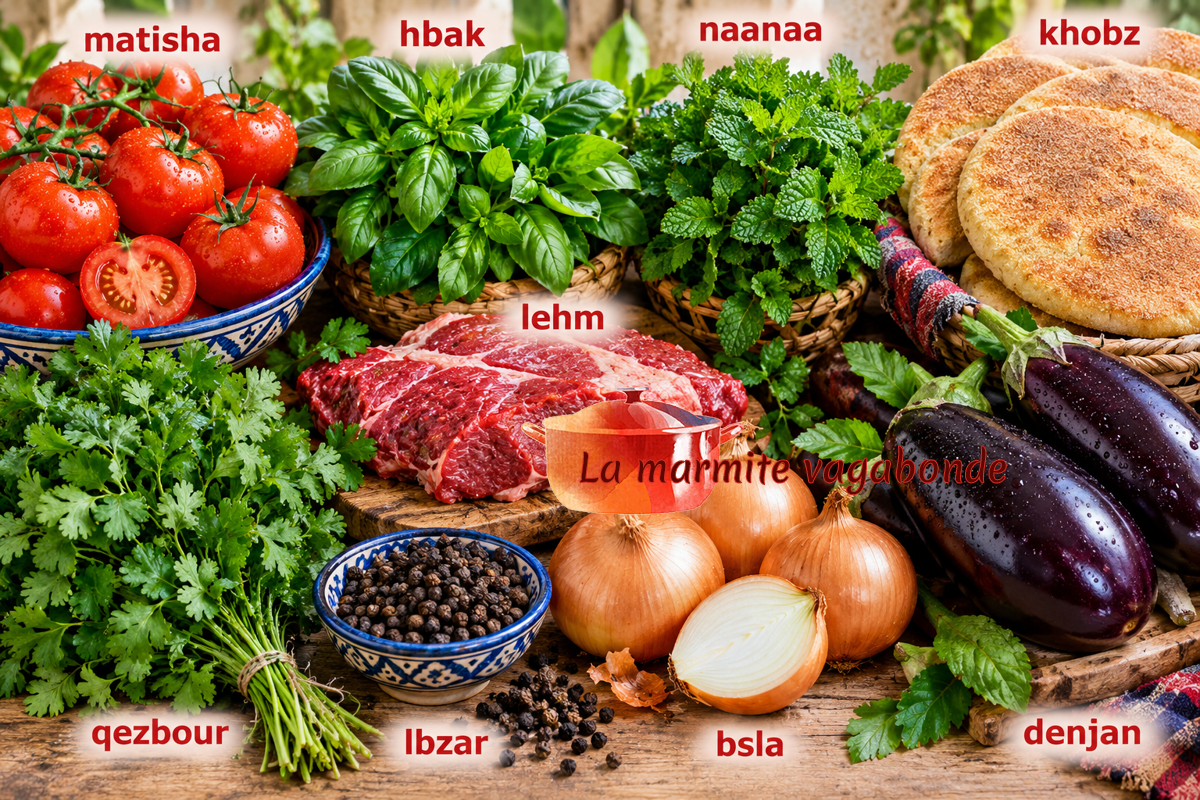
For example, we learn that ‘tomato’ is matisha, whereas in Standard Arabic it is tomata. We also learn that ‘basil’ is lehbak or hbak (with or without the article), whereas in Standard Arabic it is rayhan.
Vocabulary is essential, of course. But learning lists of hundreds of words, without practising or using them in sentences, is off-putting. It reminds me of learning irregular English verbs, or German prepositional verbs…
What’s more, these lists have two shortcomings:
- They just give the words, without the pronunciation. Without the ‘grammar’ (gender, plural);
- some mix Darija and Standard Arabic
Which language? Arabic, Darija, Berber, Southern Berber, Northern Berber?
For me, it was all the more complicated because my in-laws speak Berber. So I learnt a few words in Berber.
For example, bread is called ‘khobz’ ( خُبْز ) in Darija and Classical Arabic (or ‘khobza’ in Darija). But in Amazigh, it is ‘aghroum’ (ⴰⵖⵔⵓⵎ).
How would you describe your meat?
In Standard Arabic, ‘meat’ is ‘Lham’ ( لحم ), and in Darija it looks similar but is pronounced differently: ‘Lehm’; in Amazigh, it is technically ‘aksoum’ (ⴰⴽⵙⵓⵎ). But my in-laws used to say ‘tifiyi’.
Next, what sort of meat? In Morocco, you’ll be offered meat for a tajine, kebabs or minced meat (kefta). In Europe, you’ve got the skirt steak, flank steak, shank, chuck, neck, spider steak, pear steak, fillet and sirloin, flank steak, ribeye, rib of beef, shank, and macreuse… I don’t claim to know exactly where all these cuts are on the animal, but when I read a recipe that calls for ‘macreuse’ or ‘aloyau’, how do I ask my butcher for them?
When it comes to fish, it’s even more complicated.
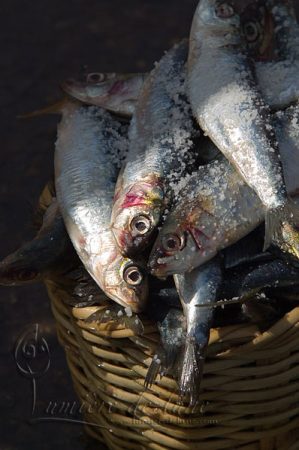
In many languages, there is some ‘ambiguity’ in the names of fish, which may refer to one or more species. In Morocco, it is even worse. Of course, there is the sardine (sardin (سَرْدِين) in Standard Arabic, serdin in Darija, sserdin or tildut in Amazigh), and the mackerel, lsqumrī (إِسْقُمْرِي) in Standard Arabic, kabayra in Moroccan Darija (كَبَايْلَة) but skombri in Algeria and Tunisia, asawru in Tamazight (ⴰⵙⴰⵡⵔⵓ), the skate… However, other names may refer to different species, depending on the region, such as cod.
Why? No doubt because fish was transported over shorter distances than meat, due to the difficulties involved in preserving it. There was therefore no pressure to standardise the names.
Furthermore, in Morocco, the names of fish in the south have been heavily influenced by Spanish, due to colonisation in areas where fish are plentiful.
In short, even vocabulary lists can be misleading.
Buying isn’t just about saying the name of an ingredient
"I’d like to order a kilo of lamb chops for Saturday."
"I’d like four bunches of basil, but I think they’re a bit pricey – can you give me a discount?"
"The pomegranates I bought last time were delicious – are these ones just as good?"…
That’s what normal interaction is like when you’re doing your shopping, and as you can see, a list of ingredients is nowhere near enough! Just one word from the sentence each time, and you’ve got to understand the reply as well!
And, no, no – not all shopkeepers speak French, and even a fewer English. In shops in big cities, yes, ‘a few’ do, but not all of them, nor in the hanouts (the little shops).
Understanding the recipes
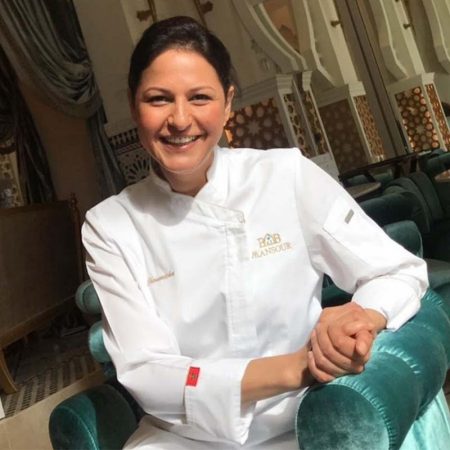
I don’t know if you’ve heard of Choumicha? She’s a very well-known celebrity chef whose YouTube channel features some wonderful Moroccan recipes. She’s a bit like the Moroccan, female equivalent of Gordon Ramsay or Jammie Oliver. But her recipes are in Moroccan!
And ‘automated’ subtitling and translation of Darija – and even Standard Arabic – isn’t quite the same thing.
Once again, looking at a video alone isn’t enough. The ingredients, quantities, cooking times… all of these are needed to understand a recipe.
So, now I’ve learnt Darija
So I took matters into my own hands and decided to take some Darija lessons. I’m far from being bilingual (my brain’s a bit slow on the uptake, and I have major difficulties with pronunciation), but things are going much better. I’m coming back to life – in the souk, in the hanouts and even elsewhere. I can make small talk with taxi drivers, understand conversations on the tram, follow videos on Facebook – in short, take part in Moroccan life.
And all that just because I was frustrated about my cooking!
Learning Darija is easier than learning Standard Arabic. It is usually written in the Latin alphabet, and its grammar is much simpler than that of Arabic (for example, there are no declensions). For practical purposes (shopping, cooking, taking a taxi, etc.) it is more than adequate, especially as Standard Arabic alone won’t be enough to understand Moroccans.
